- Cash Flow U Chronicles
- Posts
- Do not Fear the Economy — Learn to Read It Like a Map
Do not Fear the Economy — Learn to Read It Like a Map
William Thompson
October 22, 2025

Every time the news mentions inflation, recession, or interest rates, most people feel one thing: fear. And it is understandable. The economy can seem unpredictable and complex, leaving many wondering what to do next: save more, spend less, invest differently, or wait it out?
But here is the truth: the economy is not meant to be feared; it is meant to be understood. When you learn to read it like a map, you stop reacting emotionally and start responding strategically.
The economy does not determine your destiny; it simply shows you the terrain. And like any good traveler, once you understand the landscape, you can navigate it no matter what the weather.
Why Most People Struggle with the Economy
It is not that people are not smart enough to understand economics; it is that most were never taught how. Headlines often focus on panic instead of patterns, and financial jargon can make everyday concepts sound intimidating.
Here is what happens when you learn to read the economy for yourself:
You gain confidence. You stop relying on fear-based news to dictate your financial choices.
You make better timing decisions. You will know when it is a good time to buy, invest, or hold back.
You see opportunities others miss. Downturns and slow periods often create the best chances to grow.
The Key Economic Indicators to Watch
You do not need a degree in finance to understand how the economy works; you just need to know what signals to look for. Think of these as your economic compass points:
Inflation Rate – Measures how quickly prices are rising. Moderate inflation means healthy growth; high inflation means your dollars lose value faster.
Interest Rates – Set by the Federal Reserve, they impact everything from loans to savings accounts. Rising rates make borrowing harder but reward savers.
Unemployment Rate – Shows the strength of the job market. High unemployment often signals slower spending and potential recession.
Consumer Confidence – Reflects how optimistic people feel about spending. When confidence drops, so does business growth.
Stock Market Trends – Not the economy itself, but a reflection of investor sentiment and business performance.
By paying attention to these signals, you can anticipate changes rather than react to them.
How to Use This Knowledge in Daily Life
Once you understand what is happening economically, you can make smarter personal and business decisions:
If inflation rises: Focus on cutting unnecessary costs, increasing income streams, and investing in assets that appreciate (like real estate or skills).
If interest rates go up: Refinance debt early, pay off high-interest loans, and use savings accounts that offer better returns.
If the job market tightens: Strengthen your skills, diversify income, and build a financial cushion.
If consumer confidence drops: Businesses should double down on providing value, not discounts; customers spend where trust exists.
The Power of Perspective
Economic downturn is part of the cycle, not the end of the road. History shows that every slump is followed by recovery, and those who prepare instead of panicking come out ahead.
When you see the economy as a map instead of a monster, you realize that every phase, growth, decline, or stability, offers unique opportunities to adjust, learn, and build.
Fear thrives in uncertainty, but knowledge creates calm.
When you understand how to read economic signs, you move from being a passenger in the economy to one steering your financial direction.
The economy will always shift, but with the right mindset and map, you can chart your own course, no matter where it turns out.
Wall Street Isn’t Warning You, But This Chart Might
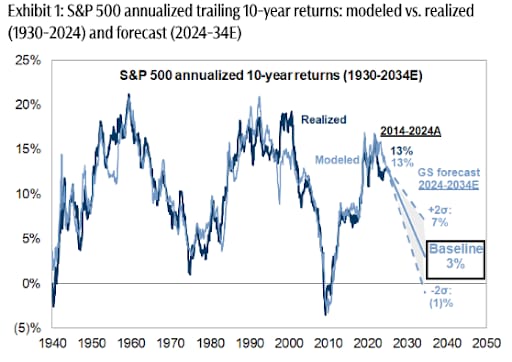
Vanguard just projected public markets may return only 5% annually over the next decade. In a 2024 report, Goldman Sachs forecasted the S&P 500 may return just 3% annually for the same time frame—stats that put current valuations in the 7th percentile of history.
Translation? The gains we’ve seen over the past few years might not continue for quite a while.
Meanwhile, another asset class—almost entirely uncorrelated to the S&P 500 historically—has overall outpaced it for decades (1995-2024), according to Masterworks data.
Masterworks lets everyday investors invest in shares of multimillion-dollar artworks by legends like Banksy, Basquiat, and Picasso.
And they’re not just buying. They’re exiting—with net annualized returns like 17.6%, 17.8%, and 21.5% among their 23 sales.*
Wall Street won’t talk about this. But the wealthy already are. Shares in new offerings can sell quickly but…
*Past performance is not indicative of future returns. Important Reg A disclosures: masterworks.com/cd.